Midterm Feedback via Google Illuminate | GenAI Essentials | Upcoming Opportunities

It’s a great time to think about receiving midsemester feedback on your course. I have written about the topics in the past on my blog, however, this time I used a new resource that might be helpful for multiple purposes:

Google Illuminate is an AI tool that creates podcast-style audio summaries of research papers. It’s designed to make complex academic information more accessible and engaging.

How it works

  1. Input a research paper, PDF, orURL into Illuminate*, or search for a topic.

  2. Illuminate generates an audio summary that explains the key points of the document.

  3. You can ask questions about the document, and Illuminate will provide a text output.

  4. You can convert the text output into a podcast answer.

*I do NOT recommend inputting copywritten information into this tool. However, it is optimized for computer science topics, and supports research papers hosted on arXiv.org

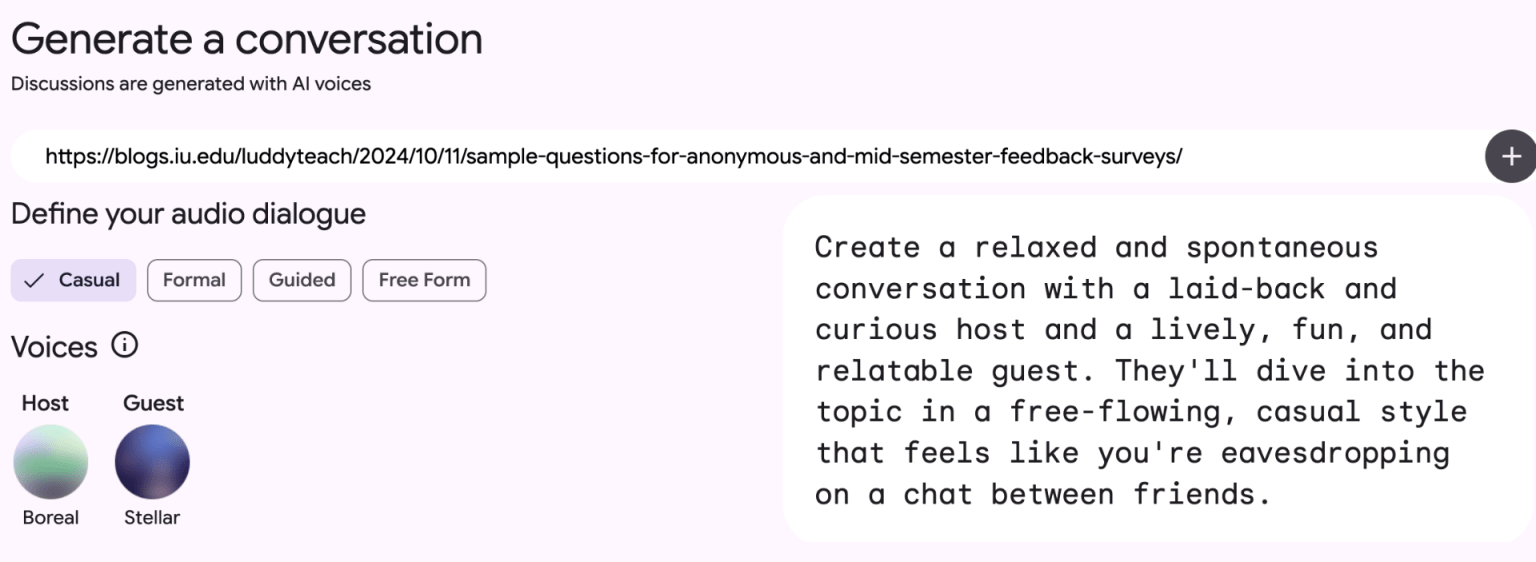
I used some of my previous blog posts to create a podcast that cover several aspects of creating developing and analyzing mid-semester feedback using the following prompt:

Create a relaxed and spontaneous conversation with a laid-back and curious host and a lively, fun, and relatable guest. They’ll dive into the topic in a free-flowing, casual style that feels like you’re eavesdropping on a chat between friends.

I used 4 resources from my blog:

Screenshot of what is now Google Notebook that shows a prompt for picking an audio for a podcast generated from my blog posts.

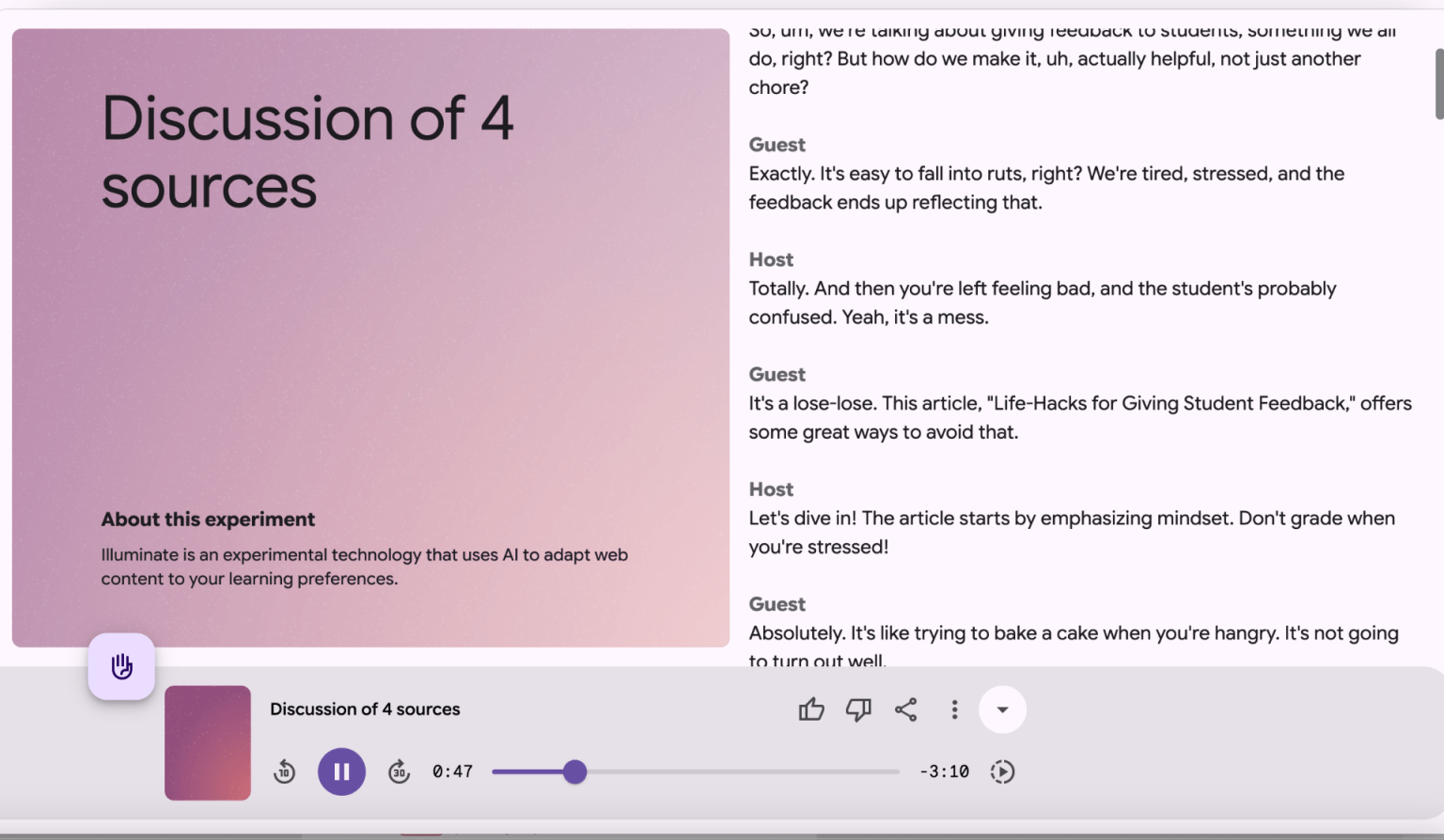
A 4-minute conversational podcast related to providing mid-semester feedback was generated that provides a decent overview of the topic is generated with a text transcript.

screenshot of the podcast interface

You might use this tool in your class to generate an overview to dense topics that students can listen to and/or read.

Resource to share with students:

GenAI Essentials: Practical AI Skills Across Disciplines (Student-Facing)

https://expand.iu.edu/browse/learningtech/courses/genai-essential-skills


This course, developed by the the Learning Technologies division of University Information Technology Services (UITS) covers:

  • Prompt Engineering – Crafting precise prompts to generate accurate and useful AI outputs.

  • Evaluating AI-Generated Content – Assessig reliability, credibility, and biases of AI-produced information.

  • Ethics and Limitations of GenAI – Understanding responsible AI use, ethical considerations, and potential risks.

  • Information Literacy in a GenAI Age – Applying verification strategies and library resources to fact-check AI-generated sources.

  • Studying and Learning with GenAI – Using AI tools for note-taking, summarization, and personalized learning support

Resource for you

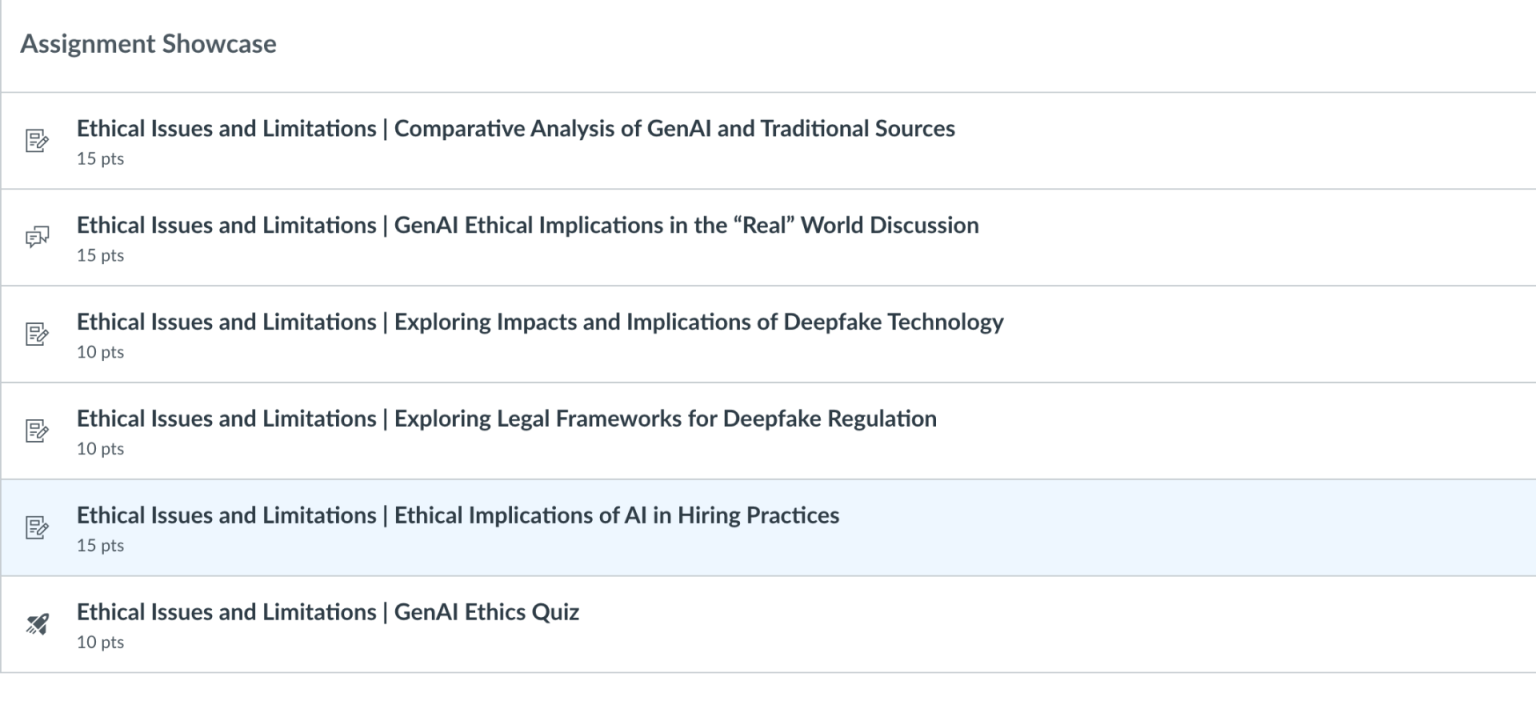
The faculty facing version of the course  https://iu.instructure.com/enroll/M7FE9Ecovers the same topics, but also includes assignment templates and rubrics that you can incorporate into your own course:

screenshot from the Canvas Gen AI Essentials at IU Course

Quick Tip: Wise Feedback

The article “Breaking the Cycle of Mistrust: Wise Interventions to Provide Critical Feedback Across the Racial Divide,” by Yeager et al. https://www.apa.org/pubs/journals/releases/xge-a0033906.pdf , introduces the concept of wise feedback; a strategy that helps instructors frame feedback in a way that communicates that students can meet high expectations and gives concrete direction for how to meet the expectations. 

The research comprised three studies focusing on middle and high school students. In the first study, students were divided into two groups: one receiving “wise feedback” and the other serving as a control. For the wise feedback group, comments on their essay drafts were paired with a note that said, “I’m giving you these comments because I have very high expectations, and I know that you can reach them.” In contrast, the control group’s note read, “I’m giving you these comments so that you’ll have feedback on your paper.” Students who received wise feedback were more likely to act on the suggestions and produced higher-quality revisions. This approach was particularly impactful for students from diverse backgrounds.

Adapting this to programming, the following steps can help provide effective feedback (from UC Berkley’s Greater Good in Education Center https://ggie.berkeley.edu/practice/giving-wise-feedback):

  • When reviewing a developer’s code or project, include the following in your feedback:

    • Start with specific actionable feedback:

      • “Your implementation meets the basic functionality, but I’ve added comments suggesting optimizations for improving performance and readability.”

      • “While your API design fulfills the requirements, the comments I left highlight ways to make the endpoints more efficient and user-friendly.”

    • State high expectations:

      • “This project is a step toward building production-ready code, which requires adherence to best practices for maintainability and scalability.”

      • “Writing clean and modular code here will prepare you for working on large, collaborative codebases in professional settings.”

    • Express confidence in the programmer’s ability to succeed:

      • “Based on your previous work, I’m confident you’ll be able to implement the suggested changes effectively.”

      • “Your problem-solving skills from earlier tasks show that you have what it takes to refine this code to meet higher standards.”

  • Additional tips to consider when using wise feedback in programming:

    • Use this type of feedback for tasks that represent meaningful learning opportunities and require the developer’s best effort, such as debugging complex issues or designing scalable solutions.

    • Incorporate this practice into a broader culture of trust, where developers feel valued and supported by their peers and mentors.

    • Avoid overpraising incomplete or substandard work, as this can unintentionally reinforce the belief that their efforts are not being taken seriously or that expectations are low.

    • While this approach benefits all developers, it is particularly impactful for those new to the field, who may struggle with imposter syndrome or worry about being judged unfairly based on stereotypes or biases.

This research emphasizes the importance of trust in the student-teacher relationship. It demonstrates that wise feedback, by directly addressing and mitigating mistrust, can significantly improve academic outcomes for underrepresented students. The findings have broad implications for educational practice by suggesting that through the lens of social-psychological theory, the study underscores how early interventions can create lasting positive effects on trust, motivation, and performance. Furthermore, the Science of “Wise Interventions” explores how social-psychological approaches can address educational disparities, reinforcing the effectiveness of strategies likewise feedback in fostering positive student outcomes: https://studentexperiencenetwork.org/wp-content/uploads/2018/08/The-Science-of-Wise-Interventions.pdf 

Sample Questions for Anonymous and Mid-semester Feedback Surveys

We have discussed the importance of getting midsemester feedback from students. Mid-semester feedback lets instructors “check the pulse” of their class partway through the semester. By surveying students, especially after a chance to evaluate evidence of learning, instructors and students alike can gain practical and actionable insights about what is working as well as recommendations for improving learning and teaching.

In addition to the general questions provided in this blog post, you may want to ask your students more specific questions about your course goals, inclusive teaching practice, classroom dynamics, pacing, and content. Curating your own questions enables you to gather targeted student feedback and be responsive to that feedback through adjustments to the course to benefit students and their learning for the rest of the semester. The following questions were developed by Poorvu Center for Teaching and Learning and the University Center for Teaching and Learning.

General Questions (pre-populated in Canvas) 

  • What is helping your learning in this class?

  • What is hindering your learning in this class?

  • What could the instructor change to improve your learning experience in this class?

  • What could you do differently to improve your learning experience in this class?

Inclusive Teaching Questions 

  • Does the instructor make you feel that you belong in the class?  What suggestion do you have for promoting a greater sense of belonging?

  • How comfortable do you feel participating in the class? Is there anything that the instructor could do to encourage more equitable participation among all of the students?

  • What does the instructor do to foster mutual respect among students?  What else could the instructor do?

  • Does the instructor teach in a manner that supports students like you to succeed? In what ways?

  • How accessible is the instructor outside of class to support you in your learning?

  • Are you able to access all course materials?  Do you have any suggestions for making materials more accessible?

Course Materials & Goals Questions 

  • Does the instructor clearly communicate course expectations?  Do you have any suggestions for improvement?

  • To what extent are the course materials valuable? Which of the materials–used in class or assigned out of class–have been most useful and least useful to your learning?

  • How has the professor’s use of materials (readings, slides, multi-media such as podcasts or films, etc.) helped you understand the subject of this course? What changes might help you learn better?

  • Is the volume of course material appropriate? Student-Learning Focused Questions

  • What are the most significant things you have learned thus far from taking this course?

  • How does the instructor help you understand what are the most important points within class? Could they do anything differently?

  • Do you feel as though your performance in the class is a reflection of your understanding of course material?  Why or why not?

  • Do you have any suggestions to improve the quality of feedback that you are getting on your understanding of course material?

Examples of questions to solicit targeted feedback on specific or new aspects of the course:

  • Which (Class activity, assessment, course material, technology tool) has been most beneficial to your learning and why?

Classroom Dynamics & Pacing Questions 

  • How does your instructor engage your attention? Are there other approaches that would make you feel engaged in the class?

  • What types of opportunities do you have to interact with the instructor and the other students in the course?  How are these interactions supporting your learning and improving your experience in the course?

  • How is the pacing of this course for you?  Do you have any suggestions for improvement?

Likert Questions If you teach a large course, reviewing qualitative questions from many students may not yield clearly defined feedback. Instead, consider using Likert scale questions, which can’t be used in the midsemester feedback tool on Canvas but can be used in various other survey options. When viewing your results, consider looking at the median and mode responses and a histogram of all of the responses, as to not allow outliers to skew your interpretation.

Below are some questions that could mostly be answered on a 1 to 5 Likert scale with 5 being strongly agree and 1 being strongly disagree.

Inclusive Teaching Questions 

  • The instructor makes me feel that I belong in the class.

  • I am able to easily get answers to questions about course material.

  • The instructor fosters mutual respect among students.

  • The instructor of the class is accessible for questions or concerns.

  • The course materials are all accessible.

Course Materials & Goals Questions 

  • The instructor communicates course expectations clearly.

  • I find the course materials to be valuable.

  • The volume of course material is appropriate.

Student-Learning Focused Questions 

  • The instructor helps me understand what the most important points within class are.

  • I feel as though my course performance is an accurate reflection of my understanding of course material.

  • I am getting enough feedback on my understanding of course material.

Classroom Dynamics & Pacing Questions 

  • I am engaged during class.

  • The level of interaction in the course is supporting my learning.

  • The pace of the course is: 1- much too fast, 2- a little too fast, 3- just right, 4- a little too slow, 5- much too slow

Examples of questions to solicit targeted feedback on specific or new aspects of the course:

  • Would you prefer more or less (discussion? lecture? small group work? presentations?)

  • Which (Class activity, assessment, course material, technology tool) contributed to your learning?