Quick Post - What Would It Look Like to Love Our Students Into Computing?

Reflections on the SIGCSE TS 2026 Keynote: Love, Learning, and Computing Education

The Pipeline Isn't Neutral

Traditional computing education often uses a "pipeline" metaphor, focusing on attracting and retaining students for technical careers. However, this approach overlooks crucial aspects like meaningful journeys, student belonging, and inclusivity. The keynote advocates for identity-affirming care in computing education. When students can fully engage, they contribute in ways that narrow, identity-stripping classrooms cannot foster.
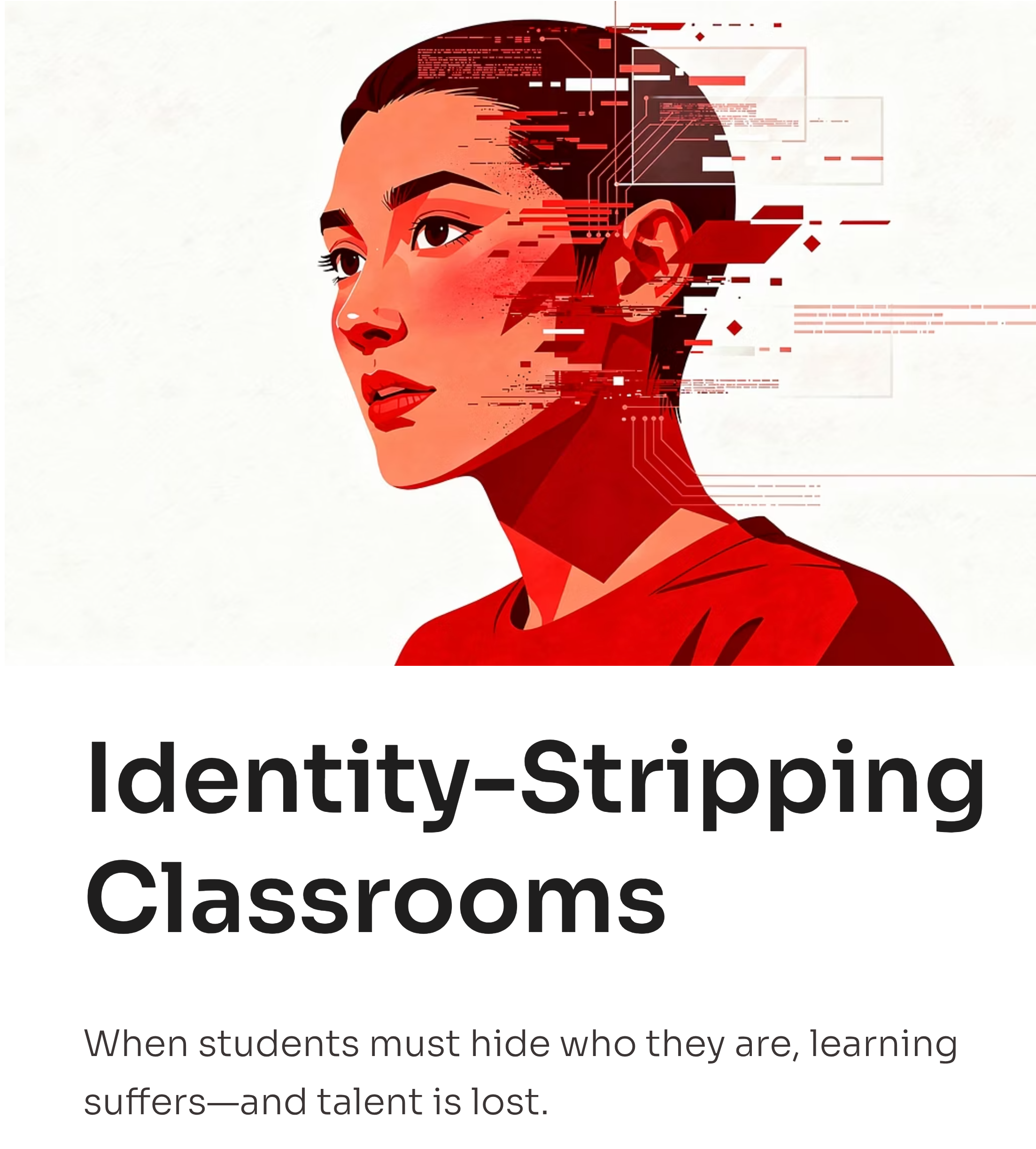
Identity Stripping Classrooms. When students must hide who they are, learning suffers, and talent is lost. Shows a person who's image looks to be breaking up in fragments

"Whatever Love" in Practice

The keynote highlights practical examples of this philosophy:

  • Kapor Center's Culturally Responsive-Sustaining CS Education Framework: This framework redefines equity-centered computing, viewing students' cultural backgrounds as assets rather than obstacles.

  • Ricarose Roque's work on family and community-centered computing: Projects like Family Creative Learning demonstrate that designing for connection and joy opens computing to a broader audience, leading to a different kind of rigor.

  • Kylie Peppler's scholarship on tools and materials: Peppler's research shows that educational materials are not neutral; they carry cultural histories and implicit messages about belonging. Arts-integrated toolkits can broaden participation and improve learning outcomes.

  • Jayne Everson's ICER 2025 paper, Dreaming of Difference: This paper emphasizes student voice, revealing that secondary students desire distributed accountability, autonomy, community, and collaboration. They seek a redefined rigor that acknowledges their whole selves.

  • Mara Kirdani-Ryan's dissertation on Identity Fragmentation: This work addresses the feeling students have of needing to suppress parts of their identity to fit into CS, identifying it as an environmental issue, not a student problem.

  • Adrienne Gifford's work on language, culture, and CS classroom practice: Gifford's projects, such as Wordplay, illustrate how valuing students' linguistic and cultural identities as intellectual resources can transform research and teaching.

Implications for Learning Design

For those in computing education, the keynote prompts a critical self-assessment: Do our choices in courses, assessments, language, and tools affirm student belonging? This has direct implications for:

  • Authentic assessment in the age of generative AI: Process-oriented evaluation, portfolio work, and student involvement in assessment design are acts of dignity, valuing how students think, not just what they produce.

  • Faculty development: Educators must understand that their choices are not neutral; they either affirm or diminish students.

  • AI in education: The tools we integrate are not neutral actors. "Whatever love" demands interrogating their underlying assumptions before introducing them to students.

A Different Kind of Rigor

The keynote doesn't ask us to lower our standards. It asks us to raise them — to hold ourselves to a higher standard of care, design, and accountability to the people we serve.

What would it mean to design a CS course as an act of love? Not love as sentimentality, but love as Roque and Peppler and Everson and Gifford are practicing it: grounded in evidence, committed to dignity, willing to be uncomfortable in service of something better.

I think that's the question worth sitting with.

Want to explore these ideas further? Watch the full SIGCSE TS 2026 keynote on YouTube, and dig into the scholars cited: the Kapor Center's CS Education Framework, Ricarose Roque's work, Kylie Peppler's research, and Jayne Everson's ICER 2025 paper.
“A Map Makes You Smarter. GPS Does Not.”: A Story About AI, Work, and What Comes Next with Jose Antonio Bowen

Jose Antonio Bowen is introduced as a Renaissance thinker with a jazz soul. His background includes leadership roles at Stanford, Georgetown, and SMU, as well as being the president of Johnstreet College. He is also a jazz musician who has played with legends, a composer with a Pulitzer-nominated symphony, and the author of “Teaching Naked,” 30% off with the code TNT30 at Wiley “Teaching Change,” and “Teaching with AI.” 30% off Teaching Change or Teaching with AI with Code HTWN at JH.

He provided a workshop for us on AI Assignment and Assessments, where he mentioned:

“A map makes you smarter. GPS does not.”

It was such a small, quiet moment, but it cracked open something bigger. Because this wasn’t just about directions. It was about how we’re all starting to think less, remember less, and—if we’re not careful—become less, all thanks to the technology we depend on.

The Decline of Entry-Level Everything

Dr. Bowen shared that Shell, a global energy giant, had laid off nearly 38% of a particular workforce group. Internships? Vanishing. Entry-level jobs? Replaced.

Replaced by what?

Artificial Intelligence

Tasks that used to belong to interns or fresh graduates—writing reports, creating slide decks, analyzing data—are now handled by machines that don’t take lunch breaks or need supervision.

And that’s where the real twist came in: the people who still have jobs? They’re not the ones who can do the task better than AI. They’re the ones who can think better than AI. Who can improve, refine, and oversee what AI produces.

If AI is writing the first draft, the humans left in the room better know how to write the final one—with nuance, clarity, and insight.

Offloading Our Minds, One Task at a Time

Back to that GPS quote. Dr. Bowen called it “cognitive offloading”—how we gradually stop using certain mental muscles because tech is doing the lifting.

We used to memorize phone numbers, navigate with paper maps, even mentally calculate tips at restaurants. Now? We ask Siri.

The scary part isn’t that we’re forgetting how to do these things. It’s what happens when we offload creativity, problem-solving, and thinking itself.

Because if AI can be creative—can write poems, code apps, design marketing plans—what do we do? What’s left for us?

Creativity, Reimagined

But here’s where things got interesting. Dr. Bowen isn’t anti-AI. In fact, he practically gushed about it.

He showed how AI can be used to spark creativity, not stifle it.

He explained how students could upload a 700-page textbook and have the AI turn it into a podcast. A nine-minute podcast. With baseball analogies, if that’s what helps them learn.

He talked about using AI to create personalized assignments: instead of a generic math problem about trains, give a politics student a question about voter turnout rates. Suddenly, they care. Suddenly, they’re engaged.

Because AI isn’t replacing the teacher—it’s becoming the chalk, the blackboard, the entire toolset that a smart educator can use to make learning come alive.

Prompt Like a Pro

Here’s another nugget that stuck with me: prompting isn’t coding. It’s storytelling.

Don’t just ask the AI to “fix your proposal.” Ask it to “transform your proposal into something your provost will love.”

Use emotion. Use intent. Give context. AI, it turns out, responds best when it knows what you’re really trying to say.

The 70% Problem

Still, AI isn’t perfect. Dr. Bowen introduced what he called the “70% problem.”

AI can do a lot of things—but only up to a C-level standard. That’s fine for a rough draft. It’s dangerous for a final product.

If students rely on AI to do the work, and they can’t take it past that 70% mark, then what happens when employers expect more?

The solution? Raise the bar.

What used to be acceptable for a B or C should now earn an F—unless the student can make the AI’s work better, smarter, more human.

From Tools to Teaching Assistants

The future of education, the he argued, is not about banning AI—it’s about designing with it.

He showed how teaching assistants could use AI notebooks filled with chemistry texts to answer student questions on the fly.
How AI can test business plans, simulate presidential decisions, or offer critiques from the perspective of a political opponent.
How students can train AI to “be” Einstein and ask it about thermodynamics at their own pace, in their own language.

AI isn’t replacing teachers—it’s becoming part of the classroom, like textbooks once were.

The Arms Race

Of course, there’s a darker side. AI can cheat. It can take online courses for students, fake typing patterns, even simulate human error.

Dr. Bowen called it an “arms race” between those building smarter AI and those trying to prevent it from being misused.

But even in this, he saw hope.

If educators embrace AI—not as an enemy but as a creative partner—they can design assignments AI can’t complete alone. They can build simulations, storytelling challenges, and editing tasks that require a human mind.

Because at the end of the day, that’s what this moment demands: humans who think more deeply, ask better questions, and create things worth remembering.

Final Words

The session ended with a simple truth:

“AI raises the floor. You must raise the ceiling.”

Whether you’re a student, a teacher, a manager, or a job-seeker, AI is now the baseline.

It will write the first draft, sketch the first idea, solve the first problem.

But it’s still up to us to bring the brilliance.

AI can produce work at a “C” level, which is problematic if students can only perform at that level. Instructors need to raise their standards and expectations. Assignments that would have been considered a “C” should now be evaluated as an “F” if they only meet the level of quality that AI can produce.

Implications

Students need to surpass AI capabilities to be competitive in the job market, especially in fields like coding and writing.

And maybe—just maybe—it’s time we all learned to read the map again.

Flippity

Flippity https://www.flippity.net/ is a free resource that allows for the quick creation of quizzes, flash cards, presentations, memory games, word searches, and more. Flippity allows users to customize premade Google Sheet templates with their own content. Instructors can use Flippity as a presentation tool, or to create low- or no-stakes assignments through Google Sheets. Further, students can use Flippity to create their own projects. This resource can be used in face-to-face and online courses, at the individual, group, or whole class level.

This video: briefly describes how many of the templated activities available on the site work.

Flippity is not a plug-in to Google Sheets, so it does not require the creation of a username or password. As such, this tool is primarily recommended for creating activities aimed at engaging students in your course.  Some of the activities can be downloaded as PDFs and distributed to students, in which case they could submit the activity via Canvas or in class.