BOOKS ON Joyful Teaching

In recent months, faculty across higher education have been grappling with unprecedented challenges: from navigating rapid technological changes and AI integration to addressing student mental health concerns and institutional pressures that often feel overwhelming. Yet amid these difficulties, educators are increasingly recognizing that joy, care, and hope aren't luxuries in teaching, they're essential to sustainable, transformative pedagogy.
This spring, as we move through another semester of complex demands, one instructional designer reached out to a vibrant community of faculty educators on a teaching and learning mailing list via the POD Network, seeking uplifting book recommendations for a faculty book club focused on joyful teaching. The response was inspiring: a treasure trove of resources that collectively argue for teaching as an act of hope, care, and human flourishing.
What makes this moment particularly ripe for these conversations? We're at a crossroads where burnout threatens to become endemic, where students are navigating their own crises of belonging and purpose, and where institutions are being called to reimagine their core commitments. The books recommended by this community offer not empty optimism, but research-informed, practice-grounded pathways toward creating classroom environments where both students and faculty can truly thrive.
Essential Reads for Joy-Centered Teaching
Joy-Centered Pedagogy in Higher Education: Uplifting Teaching and Learning for All
Lori Gonzalez, Editor
(Open Access)
(https://doi.org/10.4324/9781003532224)
This collaborative collection stands out not only for its accessibility, it's completely open-access, but for its practical wisdom. Editor Lori Gonzalez has structured the volume with "reader reflection" questions at the end of each chapter and a compilation of teaching tips that serve as perfect discussion fodder for book clubs. Currently leading a book group on this text, Gonzalez notes that she's "chunked" chapters together thematically to facilitate deeper conversation. The beauty of this resource is that it doesn't just theorize joy; it provides concrete pathways to implement joy-centered practices across diverse educational contexts.
A Pedagogy of Kindness
by Catherine Denial
https://www.oupress.com/9780806193854/a-pedagogy-of-kindness/
This book emerged repeatedly in the recommendations, with one educator noting they "can't recommend it highly enough." Another shared that their Early Career Learning Community recently completed the book, which "prompted us to challenge our assumptions about 'rigor' and 'good teaching' and to rethink our classroom practices to foster meaningful learning, and student and faculty success." During the initial pandemic year, faculty found solace in Kevin Gannon's Radical Hope, which Denial's work extends and deepens. A Pedagogy of Kindness by Denial was also specifically recommended for its ability to reframe what we mean by rigorous, meaningful education.
Institutional Transformation and Care
Hope Circuits: Re-wiring Universities and Other Organizations for Human Flourishing
by Lee Skallerup Bessette (McGill–Queen's University Press, 2024)
(Available with discount code MQ25)
https://www.mqup.ca/hope-circuits-products-9780228020677.php
Written precisely for educators "trying to do hopeful, joyful, justice-oriented work inside institutions that often feel like they're fraying," Bessette's book tackles the gap between our aspirations for higher education and institutional realities. This book is particularly valuable for those who want to think beyond individual classroom practices to consider how institutions can be restructured to support human flourishing at every level.
The Caring University
by Kevin McClure
https://www.press.jhu.edu/books/title/53820/caring-university
McClure provides a research-informed account of how institutions can center care—not as empty rhetoric, but as "a set of practices, structures, and leadership habits that make joy and belonging possible for students, staff, and faculty." At a time when care is often dismissed as soft or secondary to academic rigor, McClure makes the compelling case that care is fundamental to educational excellence. Multiple educators in the discussion highlighted this as particularly relevant for current institutional challenges.
The Science and Practice of Emotional Engagement
The Spark of Learning: Energizing the College Classroom with the Science of Emotion
by Sarah Rose Cavanagh
Cavanagh's central argument is elegantly simple yet profound: emotions are contagious, and "conveying passion, enthusiasm, and love for learning in the classroom is the best route to motivating student engagement and thus learning." While acknowledging the book is "getting a little long in the tooth," its core insights remain powerfully relevant. This text serves as foundational reading for understanding how joy operates neurologically and socially in learning environments.
The Joyful Online Teacher: Finding Our Fizz in Asynchronous Classes
by Flower Darby (forthcoming April 2026)
https://www.amazon.com/Joyful-Online-Teacher-Finding-Asynchronous/dp/080619653X
Extending Cavanagh's work into the specific context of asynchronous online learning, Darby addresses what many see as particularly "joy-less" educational spaces. However, the author notes that "the research and theory I present is applicable in all classes, not just online. Many of the concrete tips I suggest can be adapted for in-person and synchronous online classes as well." This book acknowledges Darby’s influence while demonstrating how joy-centered pedagogy must adapt to evolving educational modalities.
The Present Professor: Teaching, Engaging, and Thriving in Higher Ed
by Elizabeth A. Norell
https://www.oupress.com/9780806194691/the-present-professor/
At a time of crisis in higher education, as teachers struggle to find new ways to relate to, think about, and instruct students, this book holds a key. Implementing more inclusive pedagogies, Norell suggests, requires sorting out our own identities. In short, if we want to create spaces where students have the confidence, comfort, and psychological safety to learn and grow, we have to create spaces where we do, too. The Present Professor is dedicated to that proposition, and to helping educators build that transformational space..
The Work of Peter Felten and Mays Imad
The discussion included strong recommendations for "literally anything by Peter Felten," particularly his scholarship on relationship-rich education and high-impact educational practices that "consistently brings together rigor, humanity, and a deep commitment to student–faculty partnerships." Similarly, educators highlighted the work of Mays Imad, "an incredible collaborator and curator" whose focus on "care, trauma-informed and hope-centered pedagogy, and the emotional/relational dimensions of teaching in times of crisis" offers essential frameworks for "how to hold both distress and joy in our classrooms."
Practical Resources and Creative Inspirations
For book clubs seeking supplementary materials, one educator recommended a "sweet little book of joy-filled teaching practices" compiled by colleagues at Dartmouth's Design Initiative—[available here as a PDF]. While not necessarily a traditional book club selection, it provides "fun, practical techniques" to energize discussions. Some educators have found joy by moving "outside the typical teaching and learning fare" to explore books like The Art of Gathering or Unreasonable Hospitality, which offer fresh perspectives on creating meaningful, joy-filled shared experiences.

Why These Books Matter Now
What emerges from this rich collection is a vision of teaching that refuses to choose between rigor and care, between justice and joy, between individual practice and institutional transformation. These authors collectively argue that in times of crisis and complexity, joy isn't a distraction from serious pedagogical work; it's essential to it.
As we navigate the remainder of this academic year and plan for the next, these resources offer not just inspiration but practical wisdom for creating classrooms and institutions where everyone can flourish. Whether you're grappling with how to integrate new technologies ethically, working to support students through multiple crises, or simply trying to sustain your own passion for teaching, this curated list, compiled by experienced educators committed to teaching and learning, provides pathways forward grounded in both research and deep care for the educational endeavor.
The timing couldn't be better to gather with colleagues, pour some coffee or tea, and explore together what it means to teach joyfully in challenging times.
Again, this list was compiled from recommendations shared by faculty educators on a mailing list dedicated to teaching and learning in higher education. Special thanks to all the contributors who generously shared their expertise and favorite resources.


Upcoming Reading Group on Critical AI
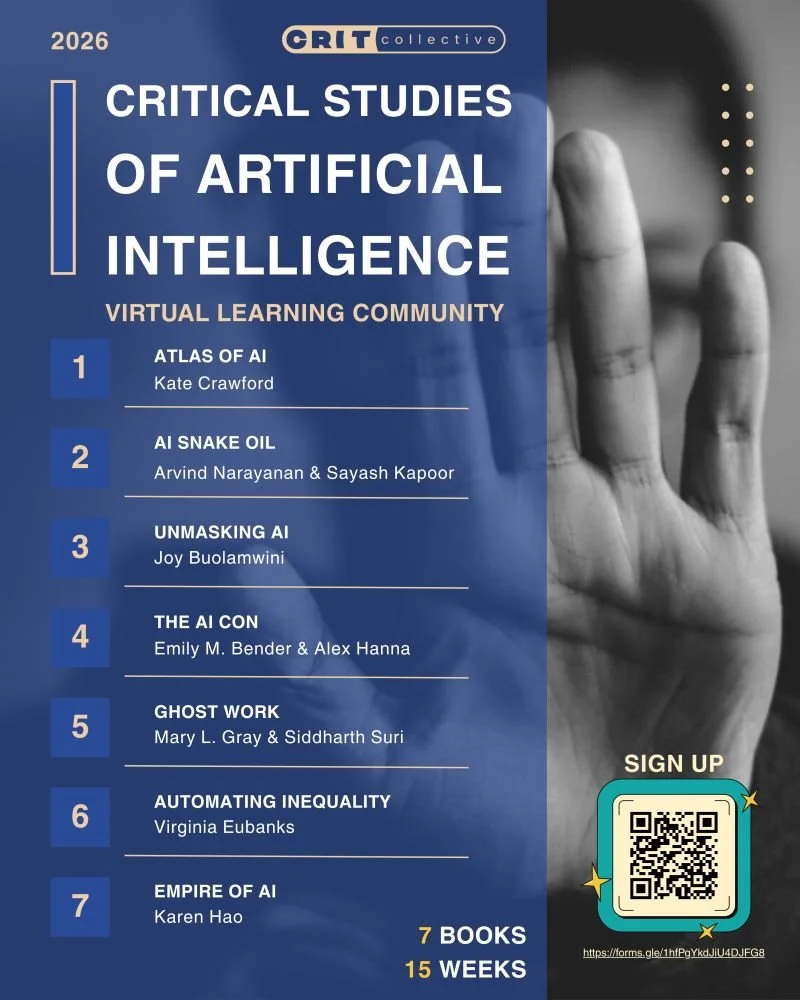
I have been spending a lot of time reading and learning about various aspects of AI, and its impact on education.(I will share more about my training and explorations in my next blog post). I recently saw the following advertised by William Frey on LinkedIN. This looks like an excellent opportunity to continue explorations (especially since I have already read some of the books), so I signed up!
I am organizing and facilitating a virtual learning community on Critical Studies of Artificial Intelligence, beginning in February 2026. Together, we will be reading 7 books over 15 weeks.
No prior knowledge is required, just the commitment to reading the books and discussing with others in the space. Please feel free to share with others (no academic affiliation is needed either, all are welcome). If you are interested in participating, please fill out the form at this link: https://lnkd.in/ejwDnBYH
If you have any questions or concerns that are not answered by the information in this message and the form, please feel free to contact [him] directly (williamfreyx@gmail.com).
Highlights from EDUCAUSE 2025
The EDUCAUSE Annual Conference took place last week in Nashville, TN.
It advertises itself as "THE event where professionals and technology providers from around the world gather to network, share ideas, grow professionally, and discover solutions to today’s challenges. It’s the largest gathering of your peers…people you can relate to, learn from, and stay connected to throughout the year".
It’s not too late to register for the online version of the conference that takes place later this week (and will feature sessions from the in-person conference in Nashville as well as exclusive new content): https://events.educause.edu/annual-conference/attend/online-conference-registration (IU is an institutional member of EDUCAUSE; you can access any of their public facing sites using your IU credentials through the SSO option if asked).
Below are a few of the featured and general session recordings from the live face-to-face meeting in Nashville.
_ Unmasking AI_ Protecting What Is Human in a World of Machines
Presenter: Joy Buolamwini
Abstract: Groundbreaking researcher, Dr. Joy Buolamwini, shares an illuminating investigation into the harms and biases of artificial intelligence. In this session, Dr Joy will explore AI in decision-making, aligning AI with fairness and organizational values and leading boldly in an AI-driven world.
Augmented Intelligence
Presenter: Jules White
Abstract: Generative AI represents a new paradigm in computing—one that centers human ideas as the starting point for computational action. Rather than relying on traditional programming, this approach allows people to express complex goals in natural language, making it possible to “compute on thought” across disciplines. This talk explores how generative AI reshapes our relationship with technology by enabling systems that respond to intent, refine outputs through dialogue, and integrate diverse tools and data. The result is a more interdisciplinary model of innovation where domain experts, creatives, and technologists collaborate through shared language. At its core, this shift is about augmented intelligence: amplifying human creativity, reasoning, and problem-solving—not replacing it—so that computing becomes a more fluid extension of human thought.
The Belonging Imperative
Presenter: Keith McIntosh
Abstract: Belonging is no longer optional — it is the defining imperative for today’s leaders! In a time when retention, engagement, and culture are under strain, leaders must intentionally design environments where people feel seen, supported, and connected. This session, led by Dr. Keith W. McIntosh, a nationally recognized higher education CIO, award-winning leader, scholar, practitioner, and thought partner on inclusive leadership and belonging, positions leaders as architects of belonging, responsible for shaping the systems, spaces, and practices that determine whether employees thrive or disengage. We’ll discuss the science of belonging and its connection to well-being, performance, and retention, while also highlighting real-world examples of leaders who embody these values. Research consistently shows that employees who feel a strong sense of belonging are more engaged, more loyal, and more productive. We’ll explore why belonging must sit alongside strategy and innovation on every leader’s agenda, and how it creates legacies that outlast titles or tenures. Participants will leave with a deeper understanding and practical strategies to embed belonging into daily leadership practices, building communities where people want to stay, grow, and contribute.
Resilient Campuses in Turbulent Times
Presenter: Freeman Hrabowski
Abstract: Higher education professionals are experiencing an unprecedented period of turbulence, resulting from significant political, demographic, cultural, and technological changes. These broad forces range from declining enrollment to shifts in employment, federal and state policy changes, and technological changes, including the ascent of generative AI. Rather than give into despair, institutional leaders, and the teams they lead can instead choose resilience, the ability to remain focused and effective in the face of these and other challenges. To address these ongoing challenges, institutions must become increasingly effective in the use of data, analytics, and AI to increase student success and ensure that people are the highest priority. The talk will highlight the importance of vision, openness, resilience, courage, passion, and hope.
Beyond the Hype: A Practical GenAI Resource Guide for Faculty in Technical Disciplines
As faculty that teach technical disciplines, you are in a unique position. You aren’t just figuring out how to use Generative AI; you are teaching the students who will build, deploy, and critically evaluate these tools for years to come.
The challenge is twofold:
How can you leverage AI to improve your own teaching (e.g., create coding examples, debug assignments, or design better projects)?
How can you effectively integrate AI into your curriculum as a core competency (e.g., teach prompt engineering, model limitations, and AI ethics)?
The internet is flooded with AI resources, and it’s impossible to sift through them all. This post is a practical, curated guide to help you find the most useful resources for your courses without the noise.
Start with IU: Key Local Resources
Before diving into the wider web, start with the excellent resources available directly from IU. These provide the foundational context and policies for our community.
Generative AI 101 Faculty Resources
Description: An overview of the GenAI 101 Course available to all at IU. Also includes a syllabus insert that can be used to promote the course to students.
Kelley School of Business “AI Playbook”
Description: A “living guide” developed by the Kelley School for faculty on the use of generative AI in teaching, grading, and research. It outlines shared values and emphasizes that faculty expertise remains central.
When to use: When you want faculty-facing guidance on when and how to use generative AI in assessments, course design, and feedback workflows.
A Quick Starting Point: Three Actionable Resources
If you want to branch out, here are three high-value resources to review in 10 minutes or less.
For Your Curriculum: Teach CS with AI: Resource Hub for Computer Science Educators
What it is: A hub specifically for integrating AI into CS courses. It includes lesson plans, project ideas, and pedagogical strategies for teaching AI in computing.
When to use: When you’re not just using AI, but actively teaching AI concepts, ethics, or applications within a CS or Informatics course.
For Your Pedagogy: Harvard University:“Teaching with Gen-AI” resources
What it is: High-level guidance from Harvard on course design, with excellent case studies and strategies for handling risks like hallucinations and superficial reasoning.
When to use: Use this before the semester starts. It’s perfect for designing your syllabus, setting AI policies, and building responsible use guidelines into your course from day one.
For Your Students (and You): AI for Education: “Effective Prompting for Educators”
What it is: A focused guide on how to write better prompts. It includes frameworks (like the “5 S Framework”) that are perfect for teaching students a structured approach to “prompt engineering.”
When to use: When you want to move students beyond simple “ask-and-receive” and teach them how to partner with AI to get better, more reliable, and more complex results.
The Deep Dive: A Curated Resource Library
For those with more time, here is a more comprehensive list organized by task.
1. How to Use AI in Your Classroom (Pedagogy & Assignments)
Derek Bok Center for Teaching and Learning (Harvard) : “Teaching in the Age of AI”
Description: A collection highlighting definitions, pedagogical questions, and course design implications.
When to use: When you want concrete assignment ideas or sample activities to see how others have used AI in their teaching.
One Useful Thing: Blog post “15 Times to Use AI and 5 Not To”
Description: Easy-to-digest guidance on where AI is helpful in learning (quantity-based tasks, translation) and where it isn’t (deep learning, high-accuracy needs).
When to use: When you are deciding which parts of your course are appropriate for AI and which should remain human-only.
Syllabi Policies for AI Generative Tools:
Description: A collection of sample policies from other educators to help you develop your own.
When to use: When you are writing your syllabus and need clear language about how AI tools are (or aren’t) allowed in student work.
2. Helping Students (and You) Get Better at Prompting
AI for Education: Prompt Library
Description: A comprehensive, searchable collection of ready-to-use prompts and templates specifically for educators.
When to use: When you need quick, plug-and-play prompt templates for lesson plans, student tasks, or administrative work.
More Useful Things — Prompt Repository for Educators
Description: A repository of prompts for instructor aids and student exercises, curated by researchers Ethan and Lilach Mollick.
When to use: When you want tested, inspiring prompt sets, especially for idea generation or in-class activities.
Description: Anthropic’s (maker of Claude) public library of optimized prompts for business, creative, and general tasks.
When to use: When you want to show students (or yourself) “what good prompting looks like” from an industry leader.
3. How to Teach AI in Your CS/InF Courses (Curriculum & Literacy)
Teach CS with AI: Resource Hub for Computer Science Educators
Description: A hub dedicated to integrating AI topics, tools, and teaching strategies in CS courses.
When to use: Use when teaching a CS course and you want to integrate AI content (topics, labs, projects) directly.
metaLAB at Harvard: The AI Pedagogy Project / AI Guide
Description: A curated site with assignments and projects to integrate AI in pedagogical practice, focused on critical thinking.
When to use: When you are designing a module on AI literacy, critical AI thinking, or assessing students’ interaction with AI tools.
Ideeas Lab: Teaching & AI resources
Description: A resource hub with teaching materials and tools, particularly aimed at engineering and technical fields.
When to use: When you want resources specifically tailored for engineering domains that integrate AI in assignments.
AI for Education: “Generative AI Critical Analysis Activities
Description: Classroom activities to help students critically examine AI outputs, ethics, and limitations.
When to use: When you want to design modules around AI ethics or have students evaluate AI rather than simply use it.
4. Taking it Further: Building Your Own AI Tools
HBSP: “How to Create Custom AI Chatbots that Enrich Your Classroom”
Description: A walk-through article for educators on designing custom AI chatbots for classroom engagement.
When to use: Use when planning to design or integrate a custom AI chatbot (e.g., as a teaching assistant, for Q&A) in your class.
OpenAI: “A Practical Guide to Building Agents” (PDF Business/Technical Guide)
Description: A detailed technical guide from OpenAI on building AI agents, including design, steps, and deployment.
When to use: Use when you or your students are planning to build or deploy an AI agent as part of a capstone or advanced project.
5. Professional Development & Staying Current
IBM Skills Build for Educators: College Educators resources
Description: A professional development site offering modules and training materials to build AI fluency and integrate digital skills into teaching.
When to use: When you want a structured PD path for yourself or want to build a course around AI literacy and workforce readiness.
University of Maine: LearnWithAI initiative
Description: A practical, “how-to” oriented site for faculty on integrating AI into courses.
When to use: Use when you want a site focused on faculty development and practical course integration.
Future-Cymbal Notion Page: Shared collection of AI-Teaching Resources
Description: A collaboratively curated Notion page of ideas, links, frameworks on AI in education; less “formal guide,” more open resource aggregation
When to use: Use when you want to browse a broad, ever-updating set of ideas rather than a polished handbook.
Description: It collects a wide variety of resources for educators around generative AI in the classroom — such as sample syllabus statements, institutional policy templates, teaching ideas, and faculty development materials.
When to use: When you are designing or revising your course syllabus and need clear language about how you will (or won’t) allow AI tools in student work.
Newsletters for Staying Current:
The Rundown -Daily newsletter summarizing AI news across research, policy, and industry.
The Neuron – Broad coverage of emerging AI trends and commentary, often with education-adjacent insights.
The Batch – Weekly deep dives into AI research, tools, and development—ideal for those following the tech side.
The Algorithmic Bridge | Alberto Romero – Thoughtful essays analyzing AI’s social, ethical, and educational impact.
Everyday AI Newsletter – Daily newsletter (and accompanying podcast) aimed at making AI accessible to “everyday people” whether educators, professionals, or non-tech specialists.
Conclusion: Start Small, Start Now
You don’t need to redesign your entire curriculum overnight. The best approach is to start small.
Pick one thing to try this month. It could be using a prompt library to help you write a coding assignment, adapting a syllabus policy, or introducing one critical analysis activity in a senior seminar. By experimenting now, you’ll be better prepared to lead your students in this new, AI-driven landscape.
Did I miss a great resource? Leave a comment and let me know!
Teaching for Integrity in the Age of AI: From Compliance to Culture

Inspired by Chapter 2 of The Opposite of Cheating: Teaching for Integrity in the Age of AI by Tricia Bertram Gallant and David Rettinger
Academic integrity is not a checklist or compliance form. It is a living culture shaped by what we model, how we design, and the conversations we hold with our students. Gallant and Rettinger remind us that integrity is cultivated through transparency, design, and dialogue, not surveillance or punishment. The real challenge now is how to teach integrity in an age where AI is everywhere.
The U.S. Department of Education’s 2023 report, “Artificial Intelligence and the Future of Teaching and Learning”, encourages educators to treat AI as a design opportunity for advancing human-centered learning, not a threat to academic honesty. Recent data highlight the urgency of this work. According to the Higher Education Policy Institute’s 2025 Student AI Survey, 92% of undergraduates report using generative AI tools, up from 66% the year before. A Guardian report found that AI-related misconduct cases have tripled since 2023. The takeaway is clear: integrity education has to evolve alongside AI literacy.
2025 Snapshot: AI & Academic Integrity
Use and Attitudes
Over 85% of undergraduates use GenAI tools (Inside Higher Ed, HEPI 2025)
61% of students want clear, course-level AI policies
33% of students were concerned about being accused of plagiarism or cheating (Campus Technology)
While 45% believe using AI for editing is “acceptable academic support”
Institutional Responses
A survey found that less than 40% of higher education institutions have formal AI acceptable use policies. (EDUCAUSE 2025)
AI-related misconduct tripled in the UK (The Guardian 2025)
76% of universities are redesigning assessments for AI contexts (UCL Education AI Survey 2025)
Faculty Trends
A significant gap exists between student and faculty adoption: only 61% of faculty report using AI in teaching, and of those, a large majority (88%) do so minimally (ASEE AI Training 2025 led by Drs. Adita Jori and Andrew Patz).
82% of instructors use GenAI for feedback or rubric design (EDUCAUSE 2025 AI Landscape Study)
Detection tools now use watermarking and metadata tracing, but false positives remain a major concern (arXiv 2025)
Model Integrity
Students notice how we work. They learn from the way we check our sources, document decisions, and acknowledge mistakes. Modeling integrity starts with transparency.
As the EDUCAUSE 2025 AI Landscape Study notes, many universities are investing in training that helps faculty engage AI responsibly. Modeling integrity now means showing how to use AI intentionally, not avoid it.
This aligns with findings from Gu and Yan’s 2025 meta-analysis, which showed that students benefit most when teachers scaffold AI use and talk openly about it. When instructors frame AI as a learning partner, not a shortcut, students develop stronger judgment and accountability.
Make Integrity Explicit
Integrity should show up as often in our discussions as it does in our policies. When we talk about it before projects, during collaborations, and after challenges, students begin to see ethics as part of the learning process.
Tricia Bertram Gallant and David Rettinger emphasize that ethical behavior thrives when it’s designed into the experience. Singer-Freeman, Verbeke, and Barre (2025) found that students across all academic levels want clear guidance on what’s acceptable AI use. If we make expectations explicit, we replace anxiety with understanding.
A recent MDPI review on Generative AI and Academic Ethics reinforces this point, noting that while GenAI can enhance engagement and efficiency, it also increases risks to originality and ethical reasoning.
Use Clear, Simple Language (The Social Institute)
Students need to understand A.I. policies to be able to follow them. That means avoiding jargon and overly technical language.
Instead of: “A.I. assistance must align with established academic integrity principles.”
Say: “You may use A.I. for brainstorming ideas, but not for writing entire sections of code or essays.”
Establish consistent Rules Across Departments or Schools
One of the biggest sources of confusion is inconsistent enforcement when it comes to A.I. rules. Departments or schools can develop a universal A.I. guidelines that applies to all instructors, rather than allowing individual educators to set conflicting rules. Over half of students (58%) report that their school or program has a policy, but a substantial number (28%) say it differs, with some courses or professors having a policy and some not (Forbes 2025). Consider creating an instructor handbook outlining departmental or school-wide A.I. best practices to make sure they are consistently communicated to students.
Frame Integrity Positively
Instead of framing integrity around rules, frame it around growth. Students respond better when they see ethical choices as part of their professional development.
A Packback editorial on academic integrity in 2025 argues that punitive detection systems often erode trust and discourage learning. When faculty shift from surveillance to conversation, integrity becomes something students take ownership of, not something they fear.
Clarify Expectations
Ambiguity creates rationalization. In the age of AI, clarity is an act of fairness.
The National Centre for AI’s 2025 student study found that first-year students, in particular, feel confused about when and how AI use is acceptable. Faculty can address this by defining boundaries early and discussing examples. Transparency about tools, citations, and documentation helps students learn discernment.
Research from arXiv’s 2025 watermarking study adds that while detection tools are improving, they still make errors. Open conversations about what these systems can and cannot do build trust and understanding. Institutions like MIT and Duke University (22 minute mark) provide sample policy language for faculty to adapt. These statements define what “appropriate help” means and require students to cite AI contributions when used. Clarity transforms anxiety into accountability.
Normalize Conversations About Ethics
Ethics belongs in everyday learning. Conversations about bias, authorship, and data use should happen alongside technical instruction.
A 2025 study on synthetic media ethics found that students value open discussions about deepfakes and misinformation but often lack the frameworks to evaluate them. Integrating these discussions into our teaching helps students connect ethics to both academic and professional practice.
Use the Syllabus as a Moral Document
The syllabus sets the tone for integrity. Transparent grading policies, clear AI statements, and flexible revision options communicate fairness and care.
Universities are redesigning their syllabi and assessments to support “authentic learning” instead of reactive policing. The University of Melbourne’s Assured Learning model and the UCL Education AI Initiativeare leading examples, focusing on oral exams, reflective portfolios, and transparent assessment design.
Respond to Misconduct Constructively
When integrity violations occur, they can become moments for growth. Reflection, accountability, and dialogue teach more than punishment ever could.
The Packback 2025 Integrity Report encourages “growth-oriented remediation,” noting that many flagged cases stem from confusion, not intention. At Indiana University, we can uphold policy while still approaching each case as a learning opportunity.
Building a Culture of Integrity
Integrity thrives when it’s shared across the institution. Faculty, staff, and students each play a role.
The University of New South Wales’ 2025 partnership with OpenAI illustrates this shift: giving staff controlled access to ChatGPT within a responsible use framework. When universities model integrity through their own practices, students learn that ethics is not a barrier to innovation—it’s the framework that sustains it.
Final Thought
Teaching for integrity in the age of AI is about creating conditions where honesty becomes the natural choice. When we model transparency, design for trust, and engage in open dialogue, we teach more than content—we teach character.
As Amanda McKenzie, Director of Academic Integrity at the University of Waterloo, Canada, shares, “Integrity is not the opposite of cheating. It’s the presence of purpose.” When that purpose runs through our teaching, policies, and partnerships, we do more than protect academic standards. We prepare students to lead with integrity in a world increasingly shaped by AI.