In the past we have discussed Universal Design for Learning (UDL), 

However, we have not formally discussed Universal Design for Instruction (UDI). While UDL and UDI are similar frameworks that are devised to optimize teaching and learning for diverse groups of students based on scientific insights into how people learn best, UDL provides specific guidance for designing curricula, while UDI can be used for applications related to teaching and learning. UDI ensures that students have multiple ways to learn, engage and demonstrate what they have learned. UDI also ensures that each UDI practice is accessible, usable, and inclusive.

According to Scott, McGuire, and Shaw (2001), there are nine principles of UDI:

  1. Equitable use: Accessible and usable by everyone.

  2. Flexibility in use: Accommodated to individual needs with choices provided.

  3. Simple and intuitive: Clear and understood regardless of student’s experience, knowledge, language skills, or current concentration level.

  4. Perceptible information: Accessible regardless of students’ sensory abilities.

  5. Tolerance for error: Anticipates learning pace and prerequisite skills.

  6. Low physical effort: Minimizes nonessential physical effort (unless physical effort is integral to the essential requirements of a course [e/g/ lifting requirements in a physical therapy program]).

  7. Size and space for approach and use: Considers physical and sensory access to environment, equipment, tasks.

  8. A community of learners: Promotes interaction and communication among students and between students and faculty.

  9. Instructional climate: Welcoming and inclusive.

The University of Washington provides a few examples of UDI (https://www.washington.edu/doit/universal-design-instruction-udi-definition-principles-guidelines-and-examples)

  • Class climate. Adopt practices that reflect high values with respect to diversity, equity, and inclusion. Example: Put a statement on your syllabus inviting students to meet with you to discuss disability-related accommodations and other special learning needs.

  • Interaction. Encourage regular and effective interactions between students, employ multiple communication methods, and ensure that communication methods are accessible to all participants. Example: Assign group work for which learners must engage using a variety of skills and roles.

  • Physical environments and products. For outside instruction, ensure that facilities, activities, materials, and equipment are physically accessible to and usable by all students and that diverse potential student characteristics are addressed in safety considerations. Example: Develop safety procedures for all students, including those who are blind, deaf, or wheelchair users.

  • Delivery methods. Use multiple instructional methods that are accessible to all learners. Example: Use multiple modes to deliver content; when possible, allow students to choose from multiple options for learning; and motivate and engage students—consider lectures, collaborative learning options, hands-on activities, Internet-based communications, educational software, field work, and so forth.

  • Information resources and technology. Ensure that course materials, notes, and other information resources are engaging, flexible, and accessible for all students. Example: Choose printed materials and prepare a syllabus early to allow students the option of beginning to read materials and work on assignments before the course begins. Allow adequate time to arrange for alternate formats, such as books in audio format.

  • Feedback and assessment. Regularly assess students’ progress, provide specific feedback on a regular basis using multiple accessible methods and tools, and adjust instruction accordingly. Example: Allow students to turn in parts of large projects for feedback before the final project is due.

  • Accommodations. Plan for accommodations for students whose needs are not fully met by the instructional content and practices. Example: Know campus protocols for getting materials in alternate formats, rescheduling classroom locations, and arranging for other accommodations for students with disabilities.

While Burgstahler (2015) explains that Effective instructors:

  1. Provide clear and explicit expectations.

  2. Provide advanced organizers and supports.

  3. Provide information in multiple formats.

  4. Provide a welcoming classroom environment.

  5. Make connections between topics and real-life experiences.

  6. Provide frequent, consistent, & formative feedback.

  7. Support individual learning needs within the group.

  8. Use effective assessment strategies.

  9. Are approachable and available.

  10. Are knowledgeable and focused on their subject matter.

  11. Make personal connections with their students.

  12. Hold challenging standards for learning.

  13. Engage in & encourage metacognition.

  14. Understand human development & learning theory

Additional Resources:

Discussing Difficult Topics

Recently, I worked with a faculty member that was trying to identify a new database to analyze in a R exercise. The dataset they usually use in their course has become politically charged in the past few months. However, the dataset is used to illustrate some of the key learning objectives of the class.

Instead of removing the dataset, we acknowledged that the right to education does not guarantee a place where one is not challenged on ones beliefs. Conversations in class can never violate the university code of conduct or create a space where it is a hostile learning environment. However, we can think through how to analyze the dataset from multiple perspectives. The University of California at Santa Barbara (UCSB) suggests:

  • allowing those that feel distressed about the topic to talk to you confidentially.

  • providing all students with enough background material and preparatory homework to participate fully in the conversation.

  • providing clear descriptions of the topic and issues surrounding it, explain why it is sensitive and why it is important to discuss it.

  • provide guidance on how to analyze and judge issues based on context and evidence (you can involve a disciplinary specific librarian in this conversation to talk about information literacy).

Also, establish a community agreement, or statement that guides how members of a classroom community (students, instructors, AIs) work and interact with each other. Ideally, it should emerge from a process implemented at the beginning of a term.

UCSB offers additional advice:

  • Be aware of your feelings, assumptions and biases, and keep your personal opinions to yourself.

  • Add dealing with controversial or sensitive topics to learning outcomes so you can focus on teaching students how to think through complex issues from multiple perspectives.

  • Add a statement to your syllabus about discussing sensitive topics.

  • Make your commitment to inclusivity, respectful interactions, and consideration for diverse perspectives clear to the students.

In short as Hogan and Sathy (2022) ask in Inclusive Teaching, Do you have a plan? Do you have rules to help everyone stick to the plan? If not, consider taking time before classes resume to develop a strategy.

Ways to Reflectively Conclude the Semester – Revisited

Here are some additions to the previous list of recommendations on how to end your semester.

Reflect on your semester (Modified from Arizona State University):

Reflection is not only an important aspect of student learning but also offers an opportunity for faculty to seek insights from past teaching experiences. At the end of the semester, when the memories are still fresh, take a few moments to reflect on each course and write down a few notes about what went well and what you would like to change in order to avoid forgetting important details over the break.

Or, invite a colleague for a coffee to chat about your courses. You can also schedule an appointment with me, or a member of CITL to reflect on your course and start strategizing a plan for the Spring Semester….

What are some steps that need to be done? By what time? Depending on the number of topics, it might be necessary to prioritize.

Collect the Best Possible Feedback from Students (from Columbia University)

Encourage your students to fill out the end of course evaluation surveys and remind them to do so. Let your students know that their feedback matters. Explain to them how you use the information they provide to help improve the course. For free-response comments, ask students to provide specific examples of what would improve the learning experience. Remind them that their responses are confidential and that instructors only receive the data after final grades are submitted.

Ask Students for Permission (From Arizona State University)

Student artifacts are a powerful and helpful resource that can be used as a model for future students or as proof of student learning. To avoid any privacy or copyright concerns, the end-of-the-semester is a good time to ask students for their written permission for sharing those artifacts with outsiders.

Thank your students for taking your class.

Even if they were required to take your class.  They will appreciate hearing you thank them.  And if you want to include providing coffee and donuts (for the smaller classes), this will show them even more appreciation.

Student Reflections 

In a previous blog post, I mentioned having current students write a letter to future students. This is a modification of the idea. Use VoiceThread for this activity. Provide students with prompts that they can discuss in an interactive video such as:

  • it most helped my learning of the content when…because…

  • it would have helped my learning of the content if…because…

  • the assignment that contributed the most to my learning was… because…

  • the reading that contributed the most to my learning was… because…

  • the kinds of homework or in class activities that contributed most to my learning were…because…

  • the approach I took to my own learning that contributed the most for me was…because…

  • the biggest obstacle for me in my learning the material was… because…

  • a resource I know about that you might consider using is…because…

  • I was most willing to take risks with learning new material when… because…

  • during the first day, I remember thinking…because…

  • what I think I will remember five years from now is…because…

Encourage them to incorporate visuals (photos of prototypes or screenshots) of anything they produced in your course.

You can allow future students to (optionally) review this feedback from students during the following semester or incorporate the feedback with the review of the syllabus. Future students appreciate reading honest information from previous students about what they can expect.

Course Mapping Templates

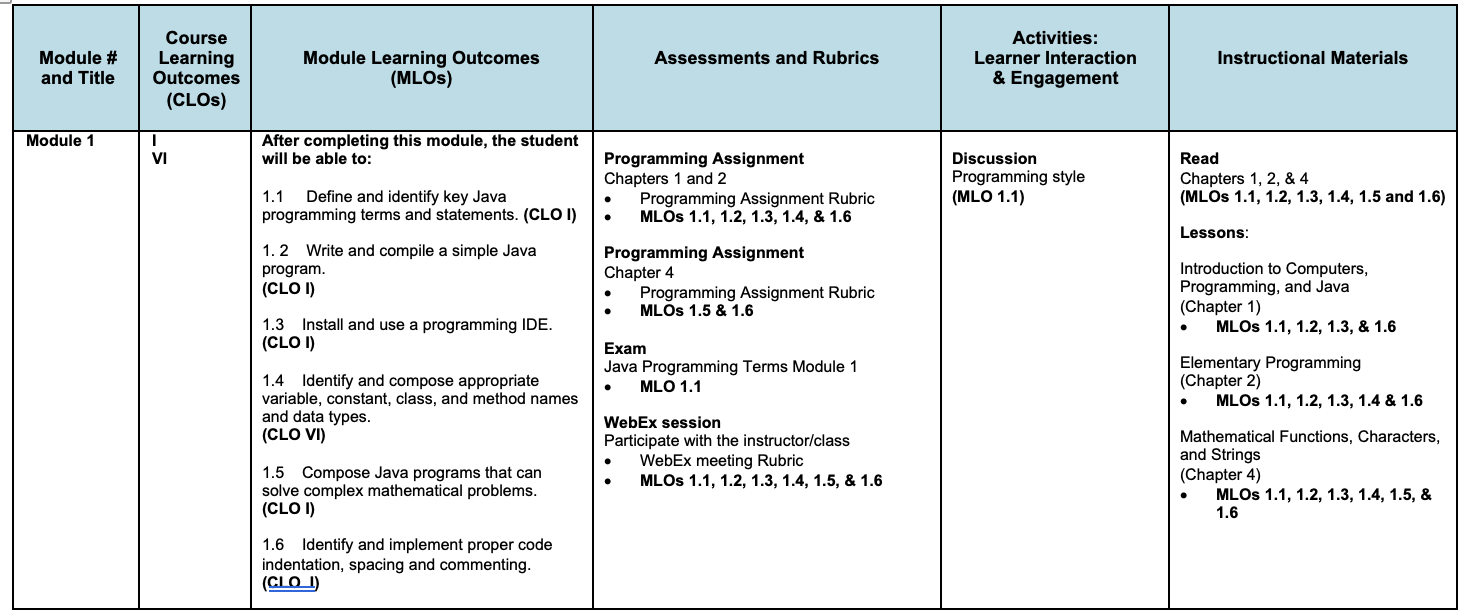
A few weeks ago, I shared some resources that included an interactive site which allowed you to plan out each lesson or module of your course. The information below can be used to help you to map out your course. Couse Mapping is an excellent approach to designing or redesigning a course. The Course Mapping Guide linked below allows you to complete a curriculum analysis of your course which results in a course map that displays the alignment of all components of a course. If you view the example on their site of the Java Programming class, you are able to see how each of the course outcomes are addressed through the modules of the course. You can also understand how the assessments and rubrics, learner interactions and engagements, as well as the instructional materials support the learning outcomes for each module: https://www.coursemapguide.com/mapping-your-course

Screen shot of course map at the modular level.

Screen shot of course map at the modular level.

Quality Matters provides a similar tool that includes a Learning Objectives Activity. This activity helps you to ensure that your learning objectives are S.M.A.R.T.:
Specific, Measurable, Achievable, Relevant, and Time Boundhttps://www.qualitymatters.org/sites/default/files/presentations/MapYourWayToAQualityCourse_HandoutLOs_ApodacaForsythe.pdf For more information see: https://www.qualitymatters.org/qa-resources/resource-center/conference-presentations/map-your-way-quality-course-course-mapping

A few more template examples can be found here:
https://nmsu.instructure.com/courses/949381/assignments/3676931

Universal Design: Implications for Computing Education

The article, Universal Design: Implications for Computing Education https://dl.acm.org/doi/10.1145/2037276.2037283 provides examples of the strategies that apply UD to instruction and assessment in the context of a computer science classroom and recommends topics for future research. The examples include:

  • Select printed materials and prepare a syllabus early to allow students the option of beginning to read materials before the course begins and allow adequate time to arrange for alternate formats, such as books in audio format or in Braille.

  • Include a statement in her syllabus inviting students to meet with her regarding learning challenges, disability-related accommodations, and/or computer and technology lab access issues.

  • Provide a comprehensive syllabus that includes learning objectives, a grading rubric, course assignments and deadlines, test dates, and student resources.

  • Arrange seating to ensure each student has a clear line of sight to her and visual aids and allow room for wheelchairs in multiple locations.

  • Give students scaffolding tools such as outlines, graphic organizers, and copies of projected materials with room for note taking.

  • Use large, bold fonts on uncluttered overhead displays.

  • Speak aloud content presented with visual aids.

  • Face the class, speak clearly, make eye contact with all students, and refer to students by name.

  • Incorporate background and contextual information.

  • Present content in a logical order, summarize what has been covered periodically, and emphasize major points.

  • Avoid unnecessary jargon and complexity; define new terms and acronyms.

  • Provide multiple examples of specific concepts to make them relevant to individuals with diverse characteristics with respect to gender, ethnicity, race, socioeconomic status, age, ability, disability, interest, and life experiences.

  • Repeat questions asked by students to ensure all have heard them.

  • Encourage students to share multiple perspectives and model mutual respect.

  • Avoid drawing undue attention to a difference, such as a disability.

  • Put class notes and assignments [in Canvas or] on a Web site in an accessible, text-based format.

  • Provide multiple ways to demonstrate knowledge, allow ample time for tests, and use a testing format that is consistent with teaching practices and assignments.

  • Provide regular feedback and corrective opportunities (e.g., allow students to turn in parts of a large programming project for feedback before the final project is due and give students some credit for correcting errors after an assignment is first submitted).

  • Know campus protocols for getting materials in alternate formats and arranging for other accommodations for students with disabilities.

  • Make sure that assistive technology can be made available in a computer lab in a timely manner when requested.

If you have time, consider sharing under this post:

What issues have you seen, or could you imagine, related to equitable treatment of people with disabilities in your classes? What are your thoughts on the approaches for making classes more accessible suggested in the article?

How do you think the concept of universal design interacts and intersects with some of the other ideas we’ve discussed this semester? How can it apply to other aspects of equity and inclusion?